
Cloud Edventures
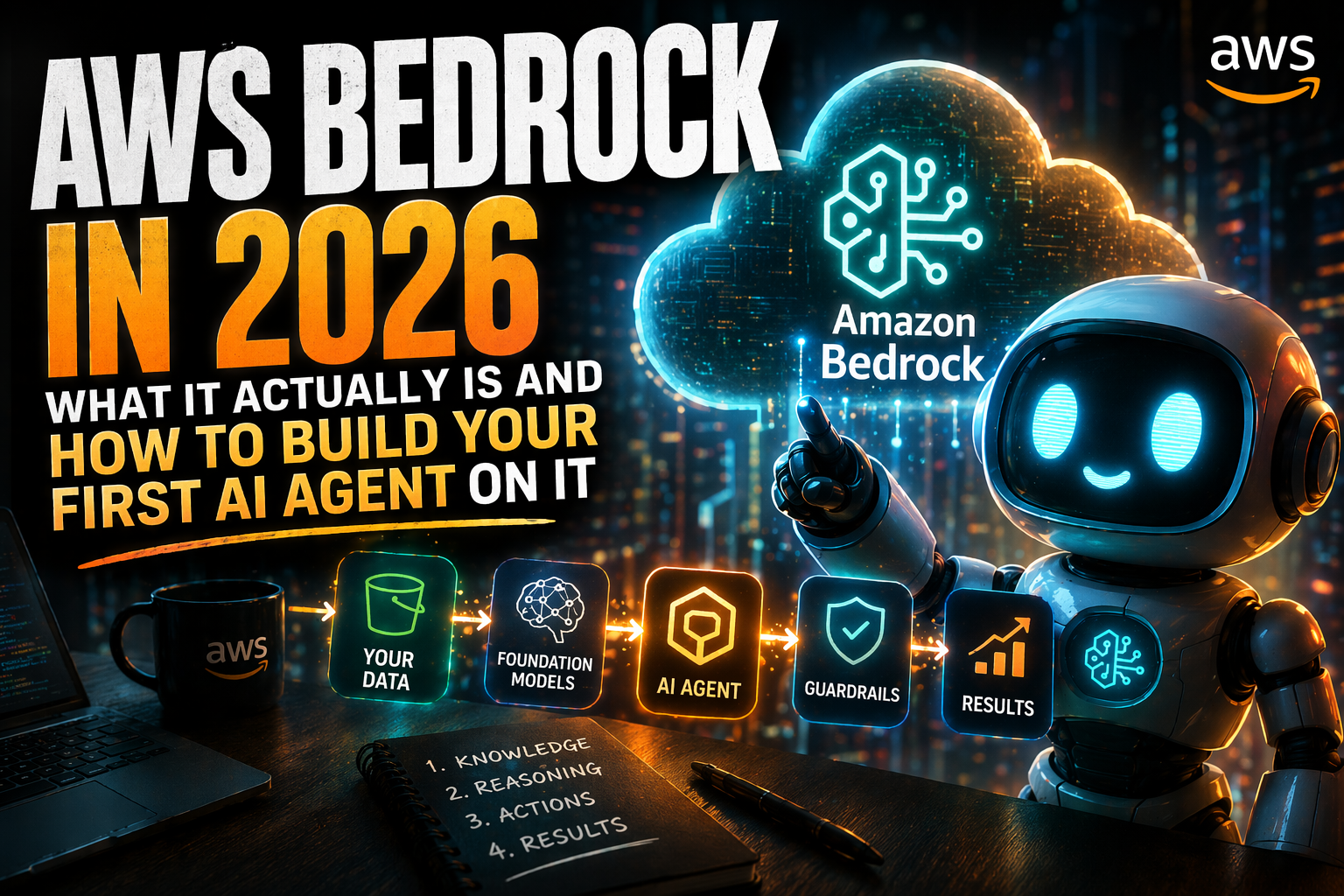
Most AWS Bedrock tutorials show you the console. This one shows you the real architecture — agentic loops, tool use, and what you need to build production AI on AWS.
If you've been following cloud trends in 2026, you've seen AWS Bedrock everywhere.
But most content falls into two categories:
Neither helps when you're trying to build real systems.
This guide focuses on what actually matters: architecture, patterns, and production pitfalls.
AWS Bedrock is a managed AI inference platform.
It gives you API access to foundation models like:
Without managing infrastructure.
The key advantage: it integrates directly with your AWS stack — IAM, VPC, Lambda, CloudWatch.
Bedrock is not just model access. It provides higher-level building blocks:
These are what make it production-ready.
Every Bedrock agent follows the same control loop:
Two outcomes:
This is the foundation of all agent systems.
import boto3
import json

client = boto3.client("bedrock-runtime", region_name="us-east-1")

def execute_tool(tool_name, tool_input):
if tool_name == "get_s3_file_list":
s3 = boto3.client("s3")
response = s3.list_objects_v2(
Bucket=tool_input["bucket_name"]
)
return json.dumps(response)
return json.dumps({"error": "Unknown tool"})

def run_agent(user_message):
messages = [{"role": "user", "content": [{"text": user_message}]}]

for _ in range(10):
response = client.converse(
modelId="anthropic.claude-3-sonnet-20240229-v1:0",
messages=messages
)

stop_reason = response["stopReason"]
output = response["output"]["message"]
messages.append(output)

if stop_reason == "end_turn":
return output["content"][0]["text"]

elif stop_reason == "tool_use":
# Execute tool and loop
pass

return "Iteration limit reached"No API keys. Access controlled via IAM roles.
CloudWatch logs latency, cost, and errors automatically.
Run AI workloads entirely inside private networks.
# WRONG
if message["content"][0]["type"] == "text":
return

# RIGHT
if stop_reason == "end_turn":
return# WRONG
messages.append(tool_result)
# RIGHT
messages.append(output)
messages.append(tool_result)Caps are safety limits — not logic.
stopReason controls execution.
Once you understand the loop, you can build:
AWS Bedrock is not just about models.
It’s about building reliable AI systems inside your cloud architecture.
Master the agentic loop — and everything else builds on top of it.
If you want to build these systems in real AWS sandboxes:
Start the Claude Architect track →
What part of Bedrock is most confusing — agents, RAG, or guardrails?
42 people reacted to this article
Written by Cloud Edventures
Previous
No more articles
Next
No more articles