
Cloud Edventures
You've studied AWS. Maybe you've even passed a certification. But when you apply for cloud engineering roles, you keep hitting the same wall: “We need someone with hands-on experience.”
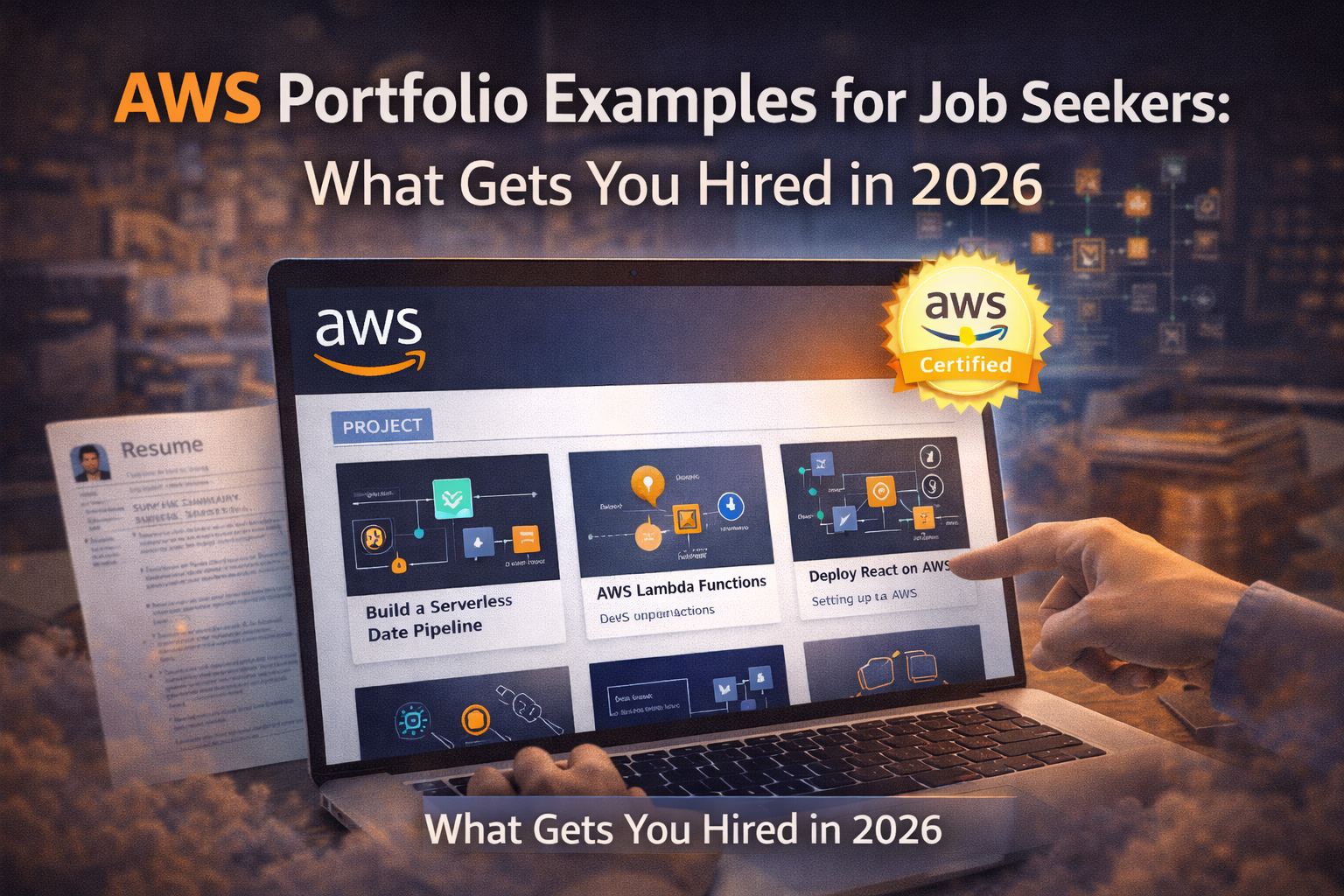
The solution is an AWS portfolio — a collection of real projects that proves you can build, not just study. This guide shows you exactly what to include, how to present it, and real portfolio structures that hiring managers actually want to see.
Certifications prove you can pass an exam. In 2026, hiring managers know that exam knowledge and building ability are very different things.
They’ve interviewed too many certified candidates who couldn’t set up a basic Lambda-to-DynamoDB pipeline under pressure.
A portfolio proves you actually built things. When an interviewer asks “tell me about a project you’ve worked on,” you have real answers with real technical decisions to discuss.
The strongest candidates have both: certification for foundational credibility, plus a portfolio for proof of execution.
Your portfolio should tell a story of growing capability. Don’t show six beginner projects — show progression.
Show you understand the core AWS building blocks.
Example projects:
What to document:
Show you can build production-style infrastructure.
Example projects:
What to document:
Show you can design real-world systems.
Example projects:
What to document:
Architecture decisions. Explain why you chose DynamoDB over RDS or Lambda over ECS.
Debugging stories. Real engineers debug problems. Share issues you encountered and how you solved them.
Security awareness. Show IAM least privilege, secret handling, and access control decisions.
Cost awareness. Demonstrate cost estimates and optimisation thinking.
Create a repo per project with:
Pros: developer-friendly and free.
Cons: no verification.
Build a portfolio website using S3 + CloudFront.
This demonstrates cloud skills while presenting your projects professionally.
However, everything is still self-reported.
Cloud Edventures missions run automated validators against your real AWS resources.
Your portfolio includes:
This adds third-party verification to your hands-on work.
Strong portfolios show variety, depth, and continuous learning.
Week 1–2: Build serverless foundations with Lambda, API Gateway, and S3.
Week 3–4: Build infrastructure automation projects with EC2, CloudWatch, DynamoDB, and CloudFormation.
Week 5–6: Build AI-powered applications with AWS Bedrock.
During this time you should also publish supporting GitHub repositories.
By week six, you can have a portfolio with multiple projects demonstrating real AWS engineering skills.
In 2026, cloud hiring increasingly prioritizes proof over credentials.
A strong AWS portfolio demonstrates:
Certifications open doors.
Portfolios prove you can walk through them.
If you're ready to build real AWS projects and create employer-ready proof:
Build your verified AWS portfolio free →
Last updated: March 2026.
42 people reacted to this article
Written by Cloud Edventures
Previous
No more articles
Next
No more articles