
Cloud Edventures
Modern data pipelines, AI workflows, and automation systems require orchestration — the ability to coordinate tasks, handle failures, and manage dependencies.
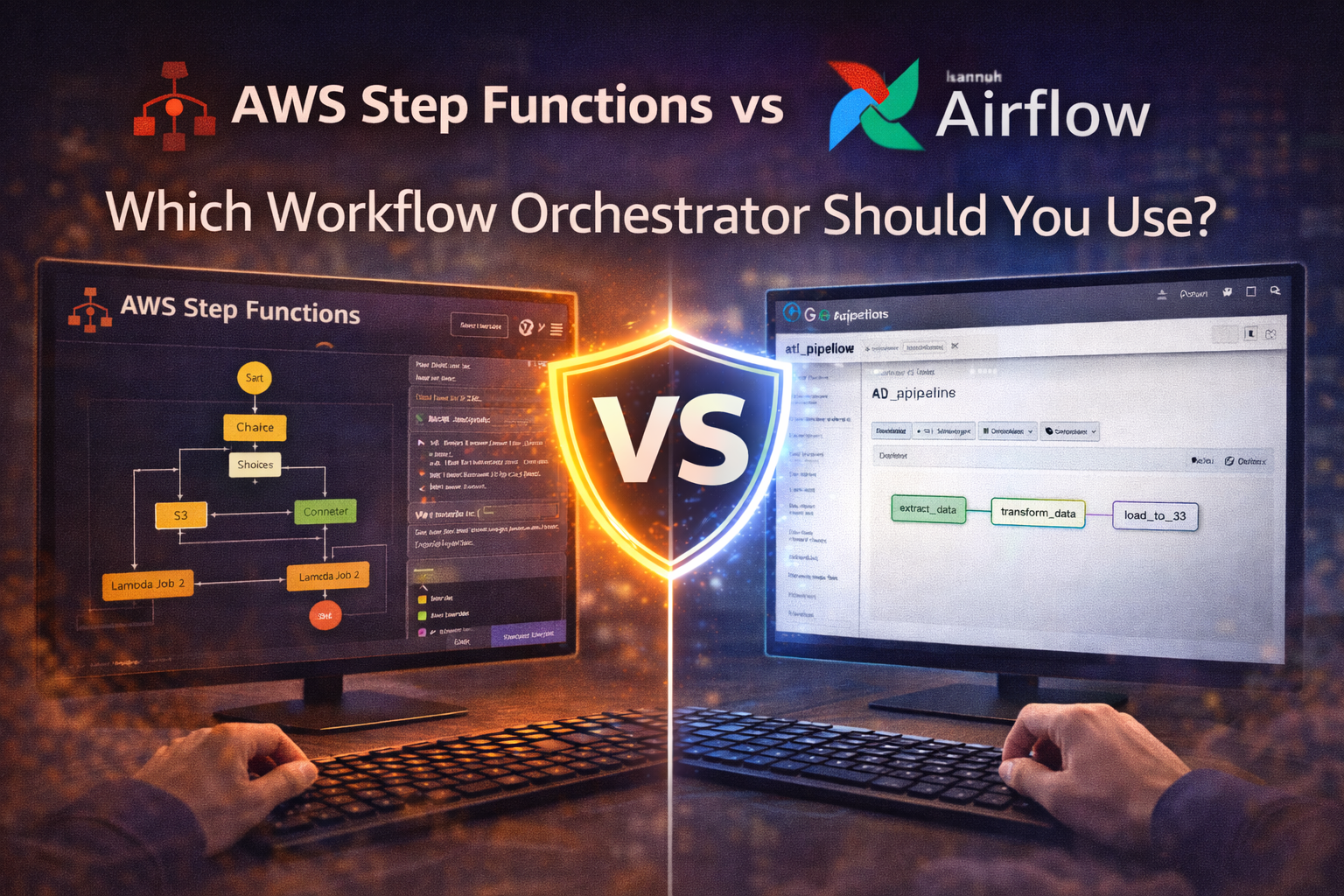
Two popular tools for this are AWS Step Functions and Apache Airflow.
Both can orchestrate complex workflows, but they are designed for different environments and engineering needs.
This guide explains the differences, when to use each, and how cloud teams choose between them in real production systems.
| Feature | AWS Step Functions | Apache Airflow |
|---|---|---|
| Type | Serverless workflow orchestrator | Open-source workflow scheduler |
| Hosting | Fully managed by AWS | Self-hosted or managed (MWAA) |
| Workflow Language | Amazon States Language (JSON) | Python DAGs |
| Best Use Case | Event-driven cloud workflows | Data pipelines and ETL jobs |
| Scaling | Automatic (serverless) | Requires infrastructure scaling |
| Integration | AWS-native services | Broad ecosystem connectors |
| Operations Overhead | Minimal | Moderate to high |
AWS Step Functions is a serverless workflow orchestration service that coordinates AWS services using state machines.
It allows you to define workflows visually or using JSON-based Amazon States Language.
Typical architecture:
Each step represents a task, and the state machine handles retries, branching, and error handling automatically.
For example:
A document-processing workflow might include:
Step Functions manages the entire pipeline automatically.
Apache Airflow is an open-source platform for programmatically authoring, scheduling, and monitoring workflows.
Workflows are defined as DAGs (Directed Acyclic Graphs) written in Python.
This makes Airflow especially powerful for data engineering teams.
A typical Airflow environment includes:
Teams deploy Airflow using Kubernetes, Docker, or managed services like Amazon MWAA.
For example:
Airflow orchestrates these scheduled tasks reliably.
Step Functions uses a serverless state machine model.
This means:
It works best in AWS-centric architectures.
Airflow requires infrastructure components:
This provides flexibility but increases operational complexity.
However, complex workflows can become verbose in JSON.
Python DAGs are often easier for developers to maintain.
Step Functions:
Airflow:
For teams without DevOps resources, Step Functions is significantly easier to operate.
AWS Step Functions
Airflow
Airflow becomes more cost-effective when running extremely large workloads continuously.
Many modern AI pipelines and microservice workflows use Step Functions.
Airflow remains a standard tool for data engineering teams.
Many companies use both tools.
Example architecture:
This allows each tool to operate in its strongest domain.
AWS Step Functions is ideal for serverless cloud workflows.
Apache Airflow is ideal for data engineering pipelines.
The right choice depends on whether your system is event-driven application infrastructure or scheduled data processing.
Understanding these trade-offs is essential for building scalable cloud architectures.
42 people reacted to this article
Written by Cloud Edventures
Previous
No more articles
Next
No more articles