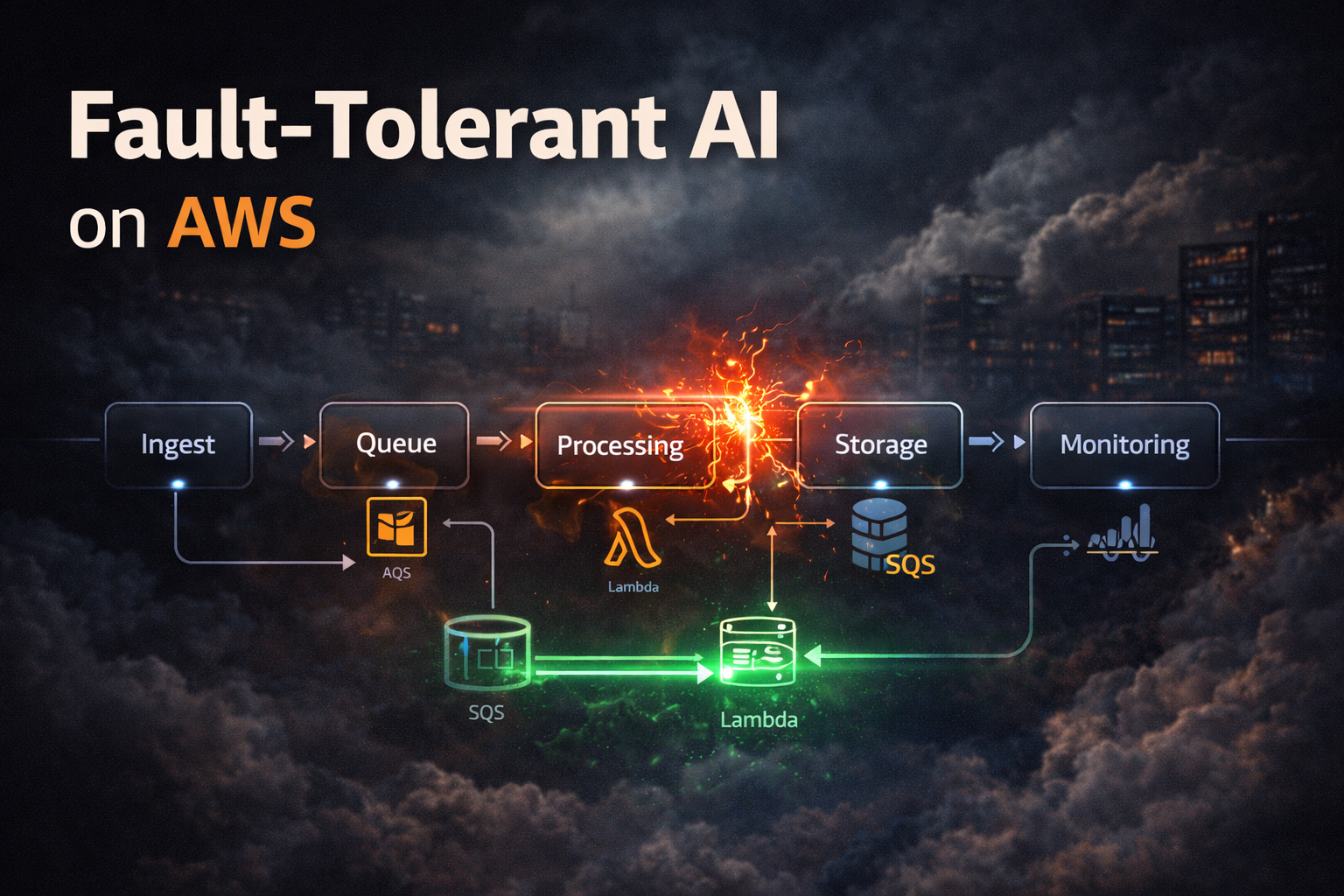
Building a Fault-Tolerant AI Pipeline on AWS Production Architecture Guide

Building a Fault-Tolerant AI Pipeline on AWS Production Architecture Guide

Cloud Edventures

Cloud Edventures

11 days ago14 min

Building a Fault-Tolerant AI Pipeline on AWS (Production Architecture Guide – 2026)

AI systems fail.

LLM APIs timeout. Containers crash. Queues overflow. External tools return invalid responses.

If you're running AI agents or LLM-powered SaaS in production, fault tolerance is not optional — it's required.

This guide walks through how to design a resilient, fault-tolerant AI pipeline on AWS.


What Is a Fault-Tolerant AI Pipeline?

A fault-tolerant pipeline continues operating even when individual components fail.

Instead of crashing the entire workflow, it:

  • Retries safely
  • Isolates failures
  • Stores intermediate state
  • Recovers automatically

AI pipelines must assume failure at every step.


Reference Architecture

Core components:

  • API Gateway or Load Balancer (entry point)
  • ECS/Fargate (AI workers)
  • SQS (task queue)
  • Step Functions (workflow orchestration)
  • Redis (short-term memory)
  • Database (persistent state)
  • CloudWatch (logging and metrics)

Each component isolates responsibility.


1. Use Queues to Decouple Services

Never let your API directly call heavy AI tasks.

Instead:

  1. API receives request
  2. Push task into SQS
  3. Worker consumes task
  4. Result stored in database

If a worker crashes, the message returns to the queue.


2. Enable Retries with Backoff

LLM APIs can fail temporarily.

Implement:

  • Exponential backoff
  • Maximum retry limits
  • Timeout thresholds

Avoid infinite retry loops.


3. Dead-Letter Queues (DLQ)

Attach a dead-letter queue to SQS.

If a message fails after multiple retries:

  • Move it to DLQ
  • Log the error
  • Trigger alert

This prevents stuck pipelines.


4. Stateless Workers

AI workers should be stateless.

Do not store memory inside container RAM.

Use:

  • Redis for short-term state
  • Database for structured state

This allows containers to restart safely.


5. Idempotency Is Critical

If a task retries, it must not duplicate work.

Use:

  • Task IDs
  • Status tracking table
  • Execution logs

Ensure repeated execution produces the same outcome.


6. Use Step Functions for Complex Workflows

For multi-step AI tasks:

  • Plan step
  • Research step
  • Execution step
  • Validation step

Step Functions provide:

  • State tracking
  • Built-in retries
  • Error branching
  • Visual workflow debugging

7. Health Checks & Auto-Recovery

Enable:

  • ECS health checks
  • Auto-restart policies
  • Auto-scaling policies

Containers should restart automatically on failure.


8. Monitor Everything

Track these metrics:

  • SQS queue depth
  • Task processing time
  • Error rate
  • Token usage
  • Memory usage

Set CloudWatch alarms for abnormal patterns.


9. Protect Against LLM-Specific Failures

AI pipelines must guard against:

  • Hallucinated outputs
  • Malformed JSON
  • Tool execution injection
  • Prompt overflow

Always validate outputs before execution.


10. Multi-AZ Deployment

Deploy across multiple Availability Zones.

Ensure:

  • Database Multi-AZ enabled
  • Load balancer spans AZs
  • Redis cluster replication enabled

This protects against infrastructure-level failures.


Common Failure Scenarios

  • LLM API rate limits
  • Worker crash due to memory spike
  • Queue overload during traffic spike
  • Network timeout between services

Your system must survive all of them.


Production Checklist

  • Queues configured with DLQ
  • Retries with backoff implemented
  • Idempotent task design
  • Stateless workers
  • Monitoring & alarms active
  • Multi-AZ enabled

If any are missing, your pipeline is fragile.


Final Thoughts

AI systems amplify failure because they are probabilistic.

Building fault tolerance is about assuming everything will fail — and designing for recovery.

Resilient AI pipelines are not built accidentally. They are engineered deliberately.

What did you think of this article?

42 people reacted to this article

Share this article

Cloud Edventures

Written by Cloud Edventures

View All Articles

Previous

No more articles

Next

No more articles