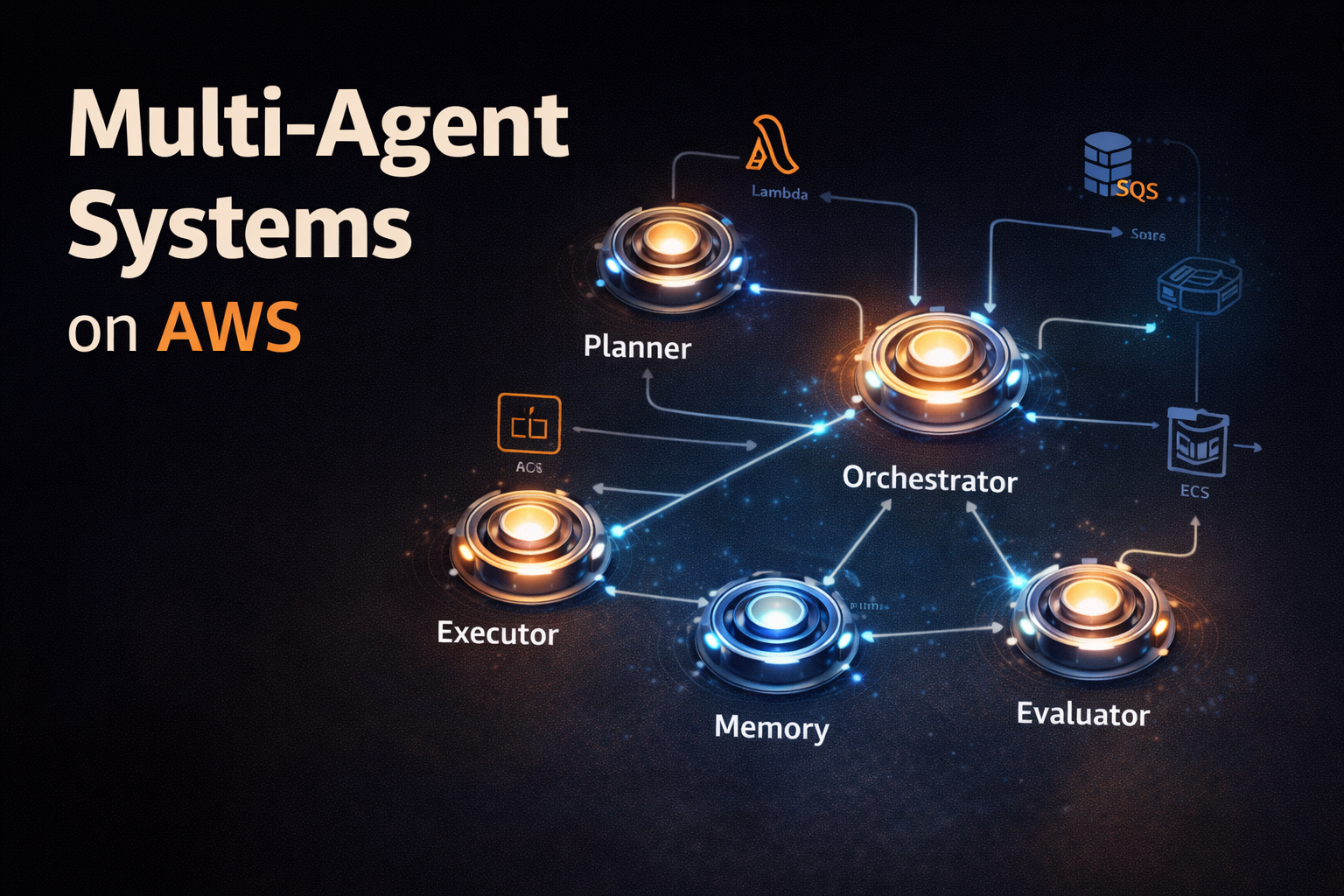
Designing Multi-Agent Systems on AWS Production Architecture Guide

Designing Multi-Agent Systems on AWS Production Architecture Guide

Cloud Edventures

Cloud Edventures

14 days ago12 min

Designing Multi-Agent Systems on AWS (Production Architecture Guide – 2026)

Single AI agents are powerful.

But multi-agent systems are where real automation begins.

If you're building autonomous workflows, research agents, task planners, or AI SaaS products, you need a scalable multi-agent architecture.

This guide explains how to design production-ready multi-agent systems on AWS.


What Is a Multi-Agent System?

A multi-agent system is an architecture where multiple specialised AI agents collaborate to complete complex tasks.

Instead of one large agent doing everything, responsibilities are distributed.

Example:

  • Planner Agent → Breaks task into subtasks
  • Research Agent → Gathers data
  • Executor Agent → Performs actions
  • Reviewer Agent → Validates output

This improves reliability, modularity, and scalability.


High-Level AWS Architecture

Core components:

  • ECS or Fargate (containerised agents)
  • SQS (task queue)
  • Redis (short-term memory)
  • Vector database (long-term memory)
  • RDS or DynamoDB (persistent state)
  • CloudWatch (logging & monitoring)

This separates compute, memory, and orchestration cleanly.


Step 1: Agent Isolation via Containers

Each agent runs in its own container.

Benefits:

  • Independent scaling
  • Fault isolation
  • Clear resource allocation

Deploy agents using ECS services with auto-scaling enabled.


Step 2: Task Orchestration Using SQS

Use SQS queues to coordinate agents.

Flow example:

  1. User submits task
  2. Planner Agent processes task
  3. Subtasks pushed to SQS
  4. Worker agents consume tasks
  5. Results stored and forwarded

This enables asynchronous, distributed processing.


Step 3: Shared Memory Layer

Multi-agent systems require shared state.

Use:

  • Redis → short-term memory
  • Vector DB → semantic long-term retrieval
  • Database → structured workflow state

Never rely only on prompt-based memory.


Step 4: Scaling Strategy

Each agent type scales independently.

Example:

  • Planner: 2 instances
  • Research agents: 10 instances
  • Executor agents: 20 instances

Use CloudWatch metrics + SQS queue depth for scaling triggers.


Communication Patterns

Common patterns:

  • Queue-based (SQS)
  • Event-driven (EventBridge)
  • State machine orchestration (Step Functions)

For complex workflows, Step Functions provides visibility and retries.


Failure Handling

Multi-agent systems must handle failure gracefully.

  • Dead-letter queues for failed tasks
  • Retry policies
  • Timeout handling
  • Circuit breakers for API failures

Never assume LLM responses are always valid.


Cost Control

Multi-agent systems can multiply LLM usage quickly.

Optimisation tips:

  • Cache repeated prompts
  • Limit recursion depth
  • Set max iteration counts
  • Use cheaper models for subtasks

Monitor token usage aggressively.


Security Considerations

  • Isolate agent IAM roles
  • Restrict network access
  • Validate tool execution inputs
  • Log every action

Multi-agent systems increase attack surface.


Production Observability

Track:

  • Task latency
  • Agent error rate
  • Queue backlog
  • Token consumption
  • Memory growth

Without observability, debugging becomes impossible.


When to Use Multi-Agent Architecture

  • Complex research workflows
  • Autonomous automation tools
  • AI SaaS platforms
  • Enterprise process automation

Do not overcomplicate simple AI APIs.


Final Thoughts

Multi-agent systems introduce power — and complexity.

The key principles:

  • Isolate agents
  • Use queues for coordination
  • Separate memory layers
  • Scale independently
  • Monitor aggressively

Design cleanly. Scale deliberately. Automate carefully.

What did you think of this article?

42 people reacted to this article

Share this article

Cloud Edventures

Written by Cloud Edventures

View All Articles

Previous

No more articles

Next

No more articles