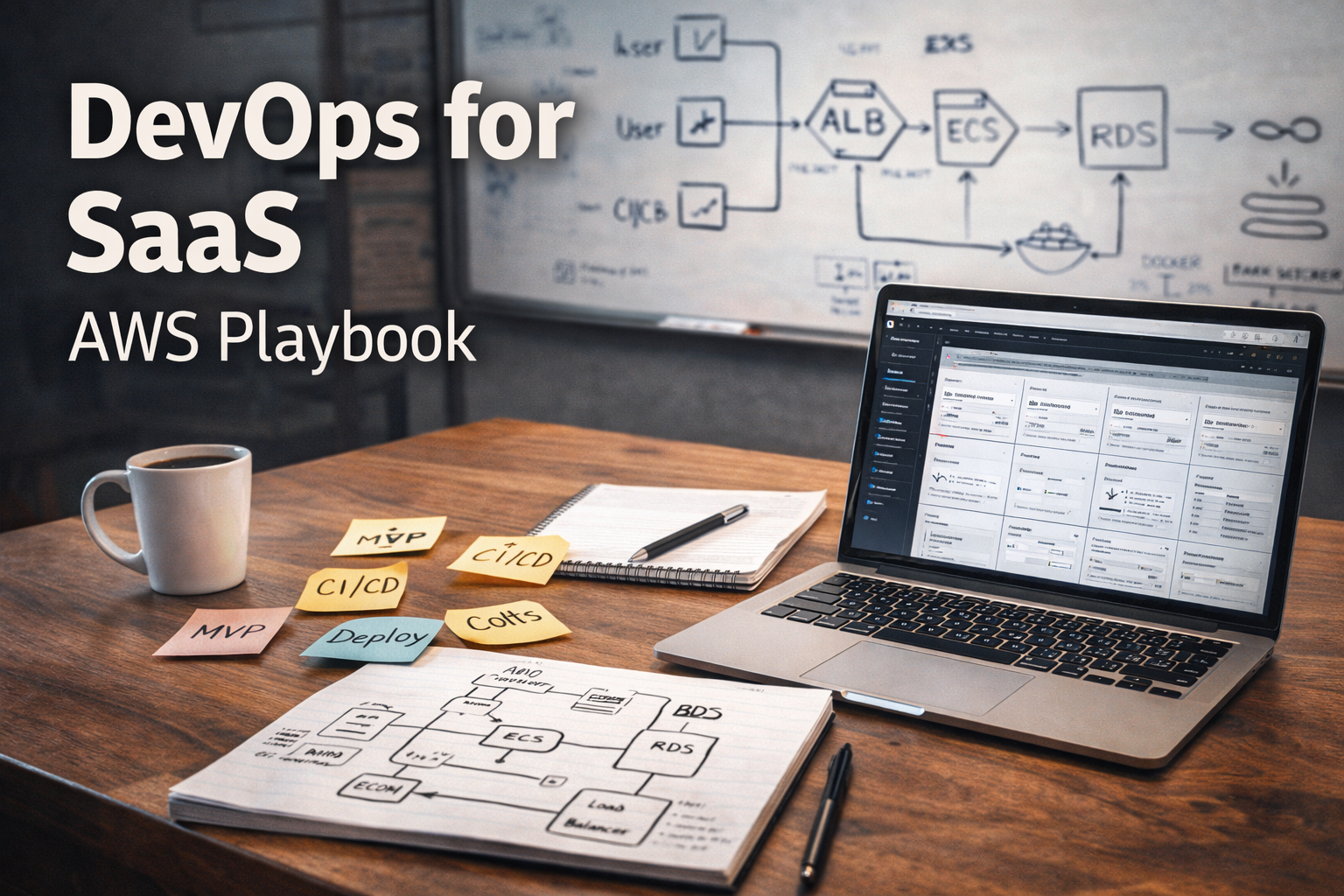
DevOps for Early-Stage SaaS (Practical AWS Playbook – 2026)
Early-stage SaaS teams don’t fail because of code.
They fail because of fragile infrastructure, manual deployments, and surprise AWS bills.
This practical AWS DevOps playbook shows you exactly what to set up from day one — without overengineering.
Stage 1: Keep Infrastructure Simple (0–1 Product Stage)
Your goal at this stage is speed and stability.
- Frontend: S3 + CloudFront
- Backend: ECS (Fargate) or single EC2
- Database: RDS (Multi-AZ not required yet)
- DNS: Route 53
Avoid Kubernetes. Avoid complex microservices.
Ship fast. Keep architecture understandable.
Set Up CI/CD Immediately
Manual deployments break startups.
Minimum setup:
- GitHub Actions or GitLab CI
- Build Docker image
- Push to ECR
- Deploy to ECS automatically
Every push to main should deploy automatically.
Use Infrastructure as Code
Never configure production manually.
Choose one:
- Terraform
- AWS CloudFormation
- AWS CDK
Benefits:
- Repeatable environments
- Disaster recovery
- Easier scaling
Logging & Monitoring (Non-Negotiable)
Set this up before you scale.
- CloudWatch logs for all services
- CloudWatch alarms for CPU & memory
- Billing alerts
- Uptime monitoring (external service)
If you can’t see it, you can’t fix it.
Cost Control from Day One
Common early SaaS AWS mistakes:
- NAT Gateway running 24/7 unnecessarily
- Overprovisioned EC2 instances
- Unattached EBS volumes
- No auto-scaling policies
Enable:
- Billing alerts
- AWS Cost Explorer reviews (weekly)
- Instance right-sizing
Security Basics for SaaS
- Use IAM roles (never hardcode keys)
- Restrict database access to private subnets
- Enable HTTPS via ACM
- Rotate secrets regularly
Security breaches destroy early trust.
Scaling Strategy (When Users Grow)
When traffic increases:
- Add Application Load Balancer
- Enable ECS auto-scaling
- Add Redis for caching
- Move database to Multi-AZ
Scale gradually. Measure before upgrading.
Backup & Disaster Recovery
At minimum:
- Enable automated RDS backups
- Store S3 versioned backups
- Document recovery steps
Test recovery at least once.
DevOps Checklist for Early SaaS
- CI/CD pipeline working
- Infrastructure as Code enabled
- Monitoring & alerts active
- Billing alerts configured
- Backups automated
- HTTPS enabled
If any of these are missing, fix them first.
What NOT to Do
- Do not adopt Kubernetes too early
- Do not microservice prematurely
- Do not manually SSH into production daily
- Do not ignore cost reviews
Complexity kills speed.
Final Advice
DevOps for early-stage SaaS is not about fancy tools.
It’s about:
- Repeatability
- Visibility
- Controlled scaling
- Cost discipline
Keep infrastructure boring, automated, and documented.
That’s how early SaaS teams scale without breaking.