
Cloud Edventures
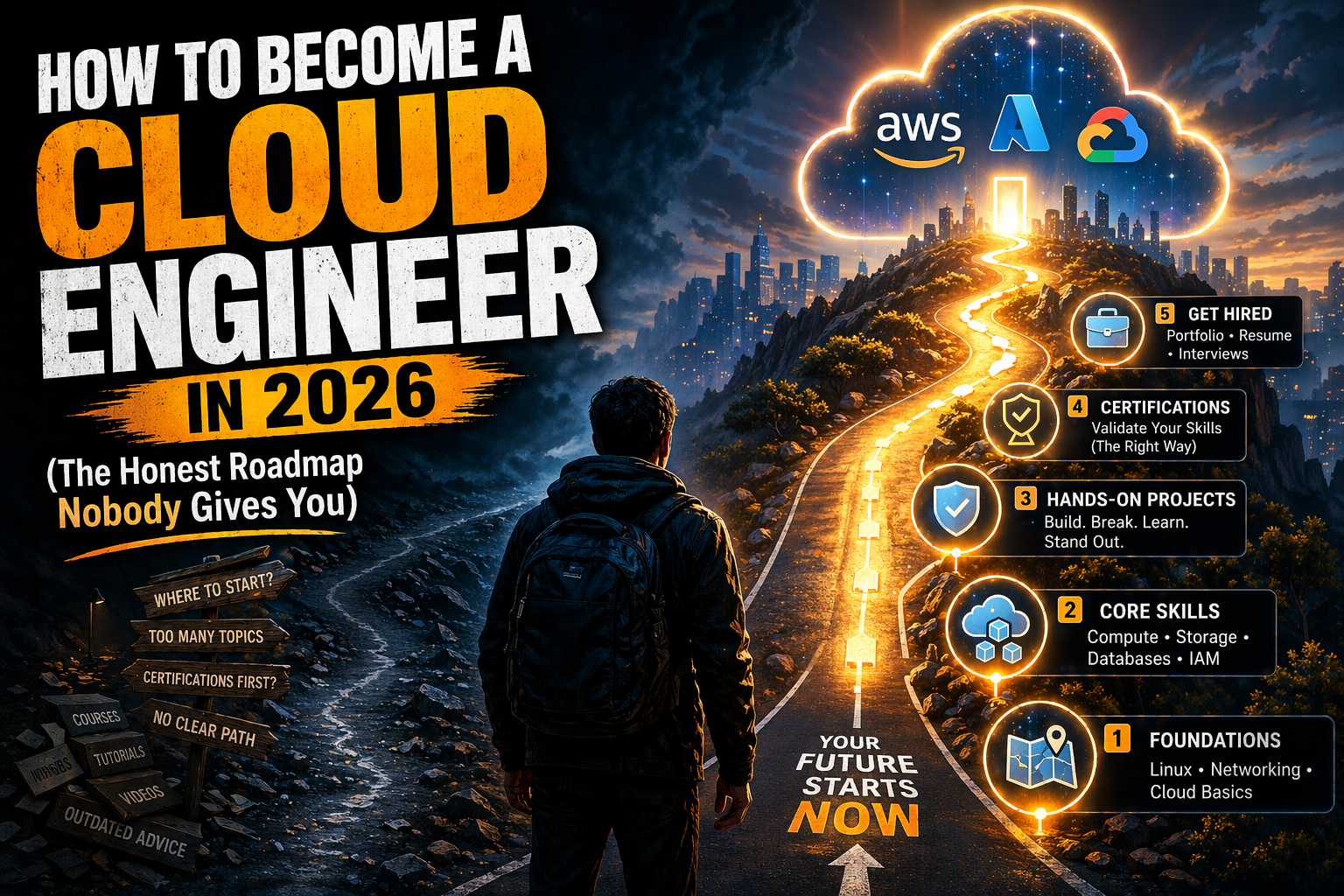
Most cloud engineer roadmaps tell you what to learn. This one tells you what actually gets you hired — and why hands-on experience beats certifications every time.
Cloud engineer is one of the most searched job roles in tech right now.
But there’s a gap nobody talks about:
What roadmaps teach ≠ what gets you hired.
Most guides tell you to collect certifications.
Real hiring decisions are based on something else entirely.
Cloud engineers don’t just “use AWS.” They build systems.
Typical responsibilities include:
The key skill:
Building systems that run without you.
Everything runs on Linux.
You must be able to:
This is your foundation.
You need to understand:
Most real-world bugs = networking issues.
Focus on building, not memorizing:
If you haven’t deployed something real, you don’t know it yet.
Learn Terraform (recommended) or CloudFormation.
Goal:
No manual console work.
Everything should be reproducible.
Use tools like:
Deploy automatically on every push.
Certifications help — but only to a point.
What they do:
What they don’t do:
Best approach:
Certification + real projects.
Build:
Rebuild the same system using Terraform.
No manual steps.
Add:
These three projects cover:
Exactly what employers want.
Practicing on AWS has a problem:
Fear of unexpected bills.
This limits experimentation.
And without experimentation, you don’t build intuition.
The solution:
Use sandbox environments where you can build freely without cost risk.
Total time: 3–4 months of focused work.
The market rewards specificity.
Not:
“I know AWS”
But:
“I built a scalable system using Lambda, DynamoDB, and Terraform with monitoring and CI/CD.”
That’s what gets interviews.
That’s what gets offers.
What part of the cloud journey are you working on right now?
42 people reacted to this article
Written by Cloud Edventures
Previous
No more articles
Next
No more articles