

If you're learning AWS or preparing for certifications, this is one concept you cannot afford to misunderstand.
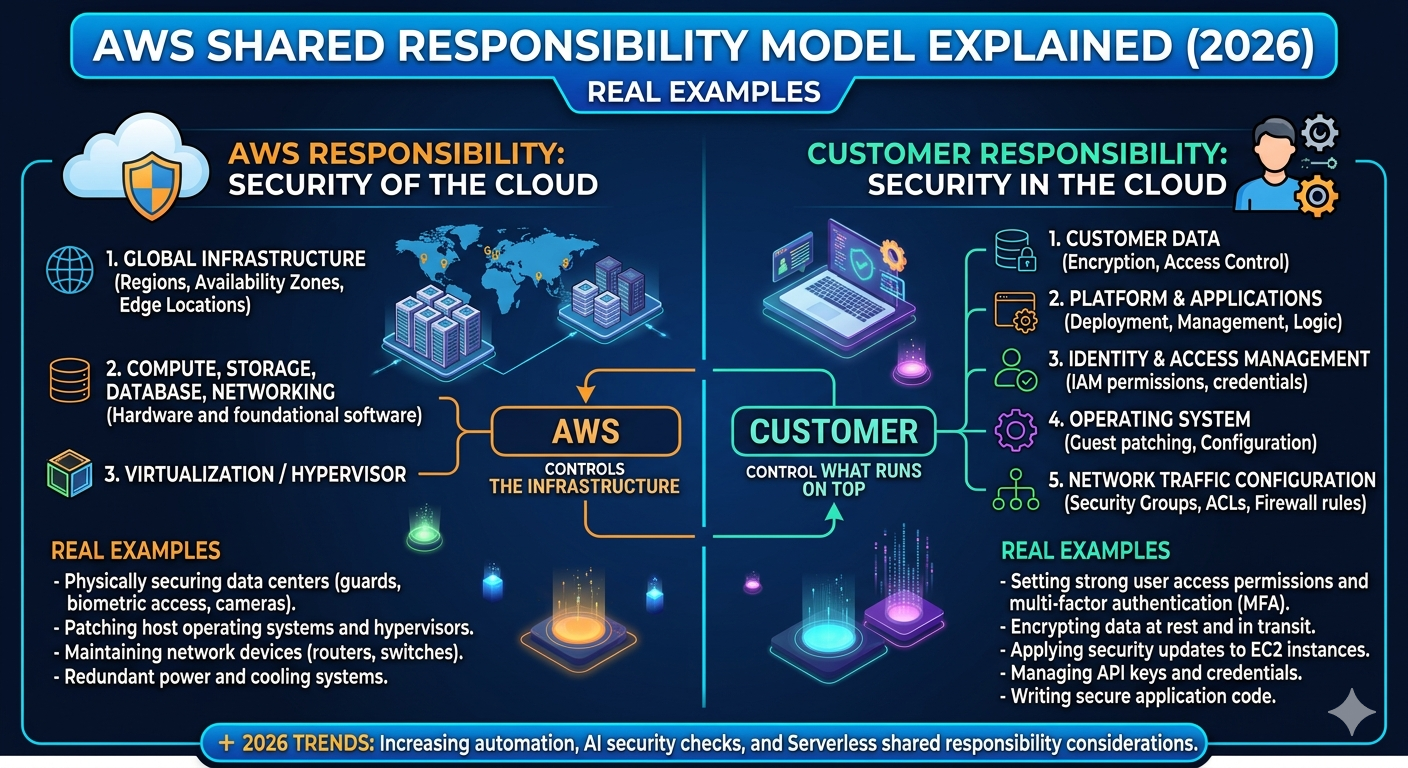
The AWS Shared Responsibility Model defines what AWS secures and what YOU are responsible for securing.
Most beginners assume AWS handles everything. That assumption leads to real security risks in production systems.
🧠 What is AWS Shared Responsibility Model? (Direct Answer)
The AWS Shared Responsibility Model is a cloud security framework where:
- AWS is responsible for security "OF" the cloud (infrastructure)
- You are responsible for security "IN" the cloud (your data & configurations)
This separation ensures flexibility, scalability, and security — but only if you understand your role.
🔐 AWS Responsibility vs Your Responsibility
| AWS Responsibility (Security OF the Cloud) | Your Responsibility (Security IN the Cloud) |
|---|---|
| Physical data centers | Data encryption |
| Networking infrastructure | IAM users & roles |
| Hardware & global infrastructure | Operating system updates |
| Managed service infrastructure | Application security |
📦 Real Example (This is Where People Get It Wrong)
You launch an EC2 instance:
- AWS secures the physical server + networking
- You must secure:
- SSH access
- Firewall rules (Security Groups)
- OS patches
If your server gets hacked due to weak passwords — that’s on you, not AWS.
⚡ How Responsibility Changes by Service Type
| Service Type | Your Responsibility Level |
|---|---|
| EC2 (IaaS) | High (OS + apps + security) |
| RDS (PaaS) | Medium (data + access control) |
| Lambda (Serverless) | Low (code + permissions) |
👉 The more managed the service, the less you manage.
🚨 Common Mistakes That Break Security
- Leaving S3 buckets public ❌
- Using overly permissive IAM roles ❌
- Not enabling encryption ❌
- Ignoring patch updates on EC2 ❌
These are the most common real-world breaches.
🧠 Why This Matters (Certifications + Real Jobs)
- Frequently asked in AWS interviews
- Core concept in Solutions Architect & DevOps exams
- Critical for production system design
If you can’t explain this clearly, you’re not ready for real cloud work.
🧪 Learn This Hands-On (Recommended)
Reading is not enough — you need to practice real scenarios.
These labs simulate real AWS environments with step-by-step validation, so you actually understand security responsibilities — not just memorize them.
🔗 Related Articles (Deep Dive)
- What Is VPC in AWS (Beginner → Advanced Guide)
- How to Become a Cloud Engineer in 2026 (Step-by-Step Roadmap)
- AWS Bedrock Explained (Build Your First AI Agent)
❓ FAQs
What is AWS responsible for?
AWS is responsible for securing infrastructure like hardware, networking, and data centers.
What is the customer responsible for in AWS?
Customers are responsible for data, IAM, configurations, operating systems, and applications.
Does AWS handle security completely?
No. AWS secures the cloud, but you must secure what you run inside it.